 Image 1 of 4
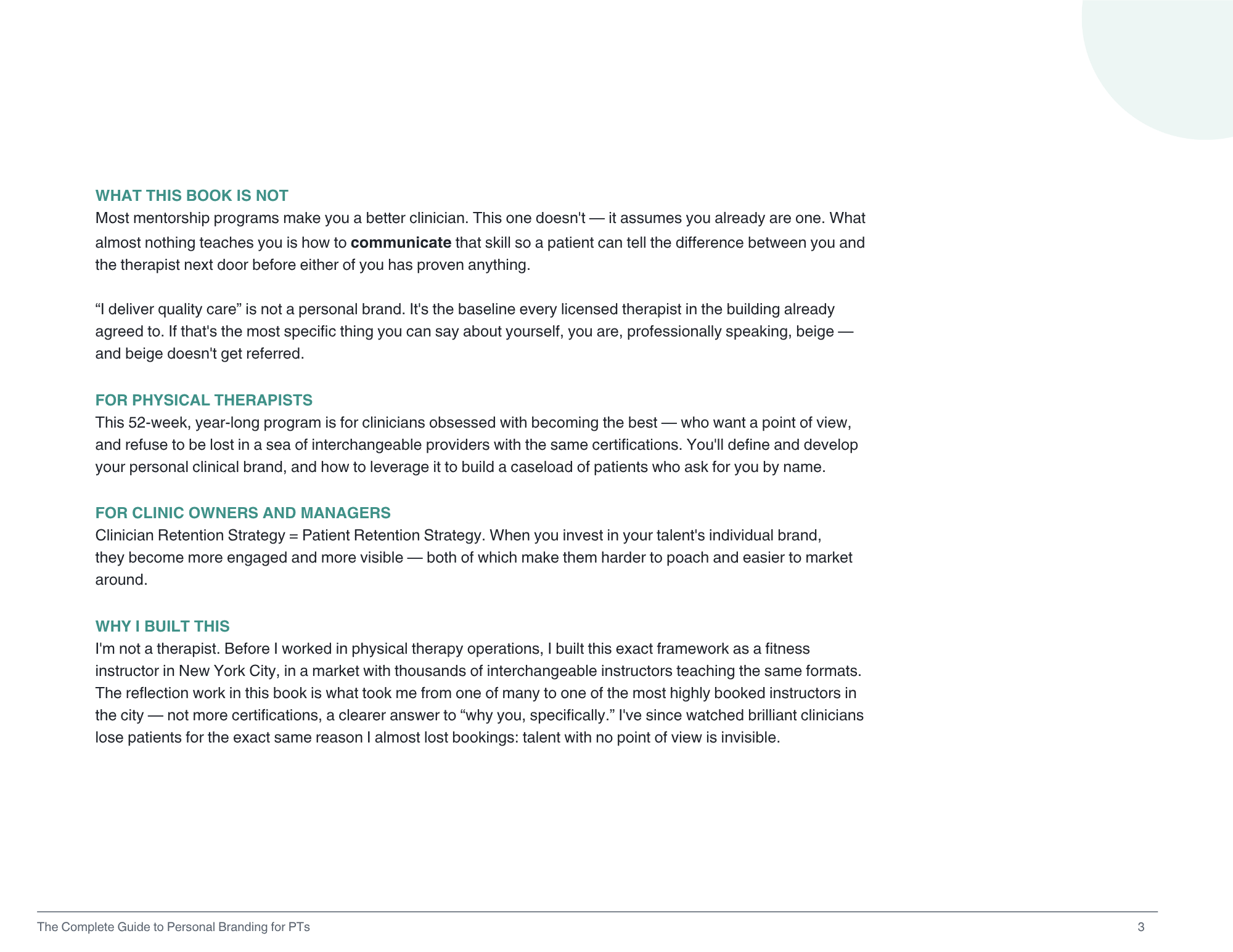 Image 2 of 4
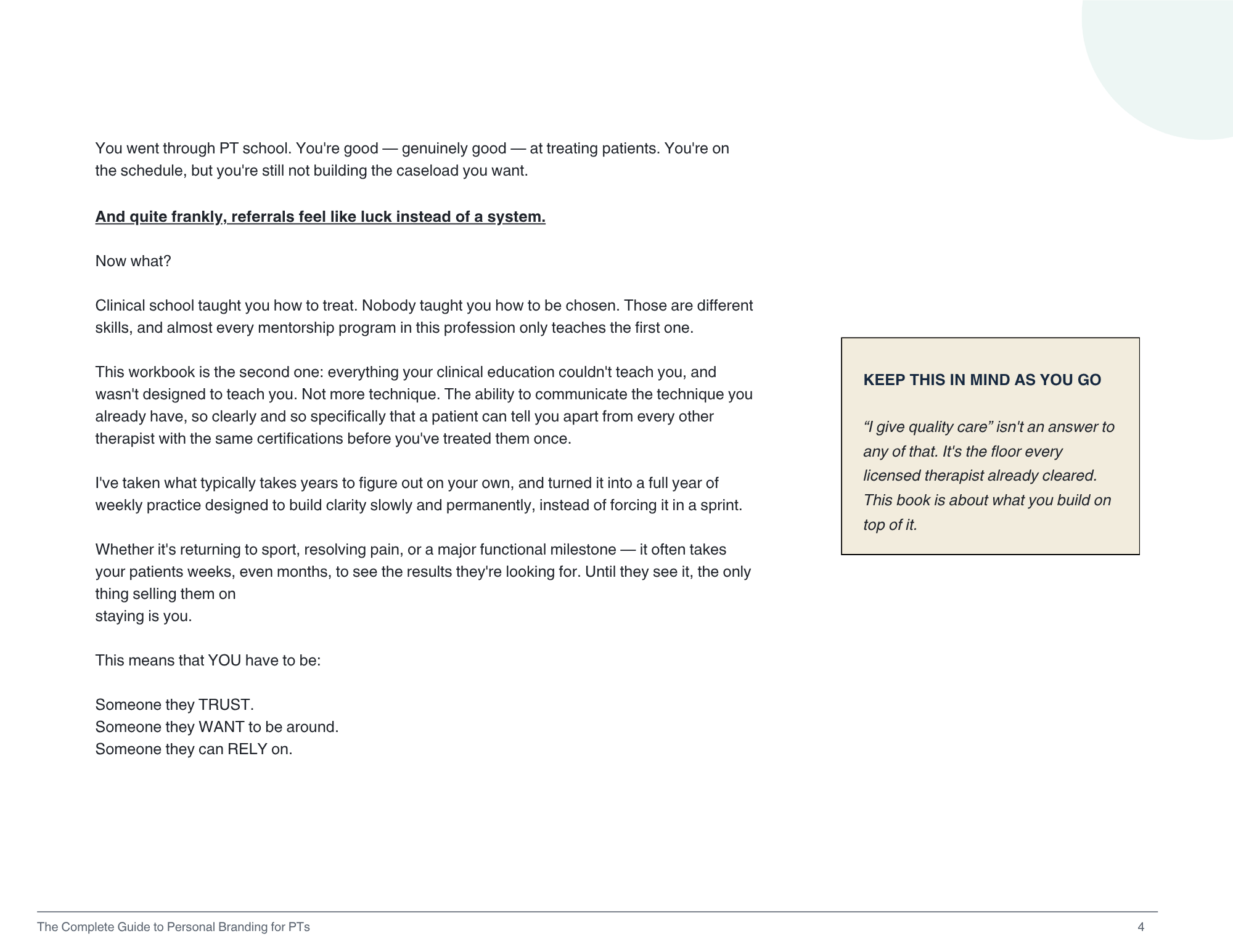 Image 3 of 4
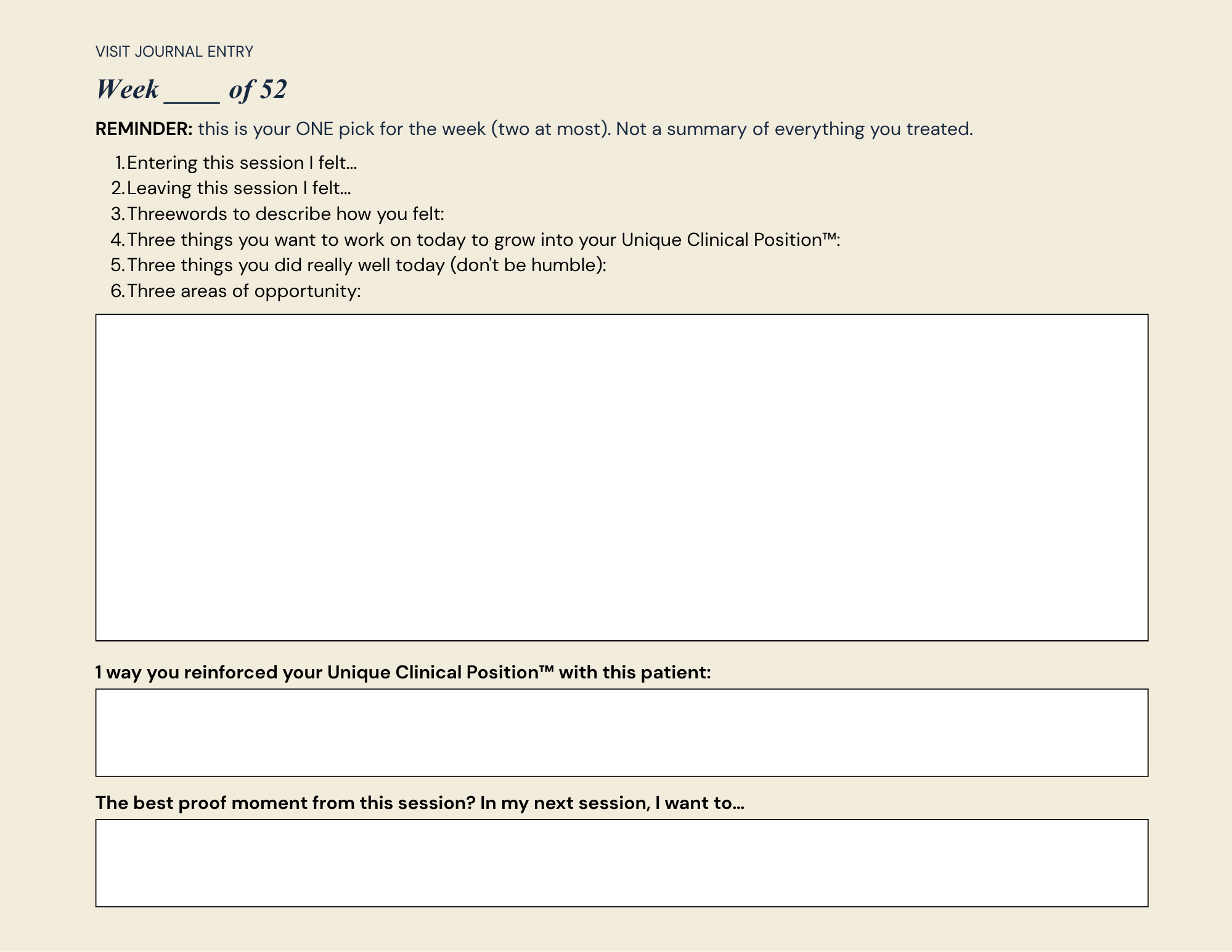 Image 4 of 4
You can be the best clinician in the building and still lose the room.
Clinical school taught you how to treat. Nobody taught you how to be desired. Those are different skills — and every mentorship program in this profession only teaches the first one.
"I provide quality, evidence-based care" is not a personal brand. It's the baseline every licensed therapist already agreed to. If that's the most specific thing you can say about yourself, you're professionally beige — and beige doesn't get referred.
This is a 52-week, year-long workbook that builds the second skill: communicating the clinical ability you already have, so specifically that a patient can tell you apart from every other therapist with the same certifications before you've treated them once.
What's inside:
The Generic Answer Test — a forcing mechanism that makes you pull from a skill, job, or world completely outside physical therapy before you're allowed to call an answer finished
Who Are You? and What Defines Your Style of Care? — guided reflection worksheets that dig past the answer every other therapist would give
Crafting Your Unique Clinical Position™ — a formula (purpose + how patients feel + how you coach them through the hardest part of recovery + what makes your proof different) plus a worked example, so you're not staring at a blank page
A 52-week journal, built around choosing just one visit a week to write about — never a summary of everything you did, because specificity is the entire point
Quarterly check-ins, a mid-year and year-end press release exercise, and a Personal Clinician Playbook you actually finish
I built this framework as a fitness instructor in one of the most saturated instructor markets in the world, and used it to grow from one of thousands of interchangeable instructors into one of the most highly booked in New York City. I've since watched brilliant clinicians lose patients for the same reason I almost lost bookings: talent with no point of view is invisible.
This workbook is for therapists obsessed with becoming the best — who want a point of view, and refuse to be lost in a sea of interchangeable providers with the same certifications.
You can be the best clinician in the building and still lose the room.
Clinical school taught you how to treat. Nobody taught you how to be desired. Those are different skills — and every mentorship program in this profession only teaches the first one.
"I provide quality, evidence-based care" is not a personal brand. It's the baseline every licensed therapist already agreed to. If that's the most specific thing you can say about yourself, you're professionally beige — and beige doesn't get referred.
This is a 52-week, year-long workbook that builds the second skill: communicating the clinical ability you already have, so specifically that a patient can tell you apart from every other therapist with the same certifications before you've treated them once.
What's inside:
The Generic Answer Test — a forcing mechanism that makes you pull from a skill, job, or world completely outside physical therapy before you're allowed to call an answer finished
Who Are You? and What Defines Your Style of Care? — guided reflection worksheets that dig past the answer every other therapist would give
Crafting Your Unique Clinical Position™ — a formula (purpose + how patients feel + how you coach them through the hardest part of recovery + what makes your proof different) plus a worked example, so you're not staring at a blank page
A 52-week journal, built around choosing just one visit a week to write about — never a summary of everything you did, because specificity is the entire point
Quarterly check-ins, a mid-year and year-end press release exercise, and a Personal Clinician Playbook you actually finish
I built this framework as a fitness instructor in one of the most saturated instructor markets in the world, and used it to grow from one of thousands of interchangeable instructors into one of the most highly booked in New York City. I've since watched brilliant clinicians lose patients for the same reason I almost lost bookings: talent with no point of view is invisible.
This workbook is for therapists obsessed with becoming the best — who want a point of view, and refuse to be lost in a sea of interchangeable providers with the same certifications.